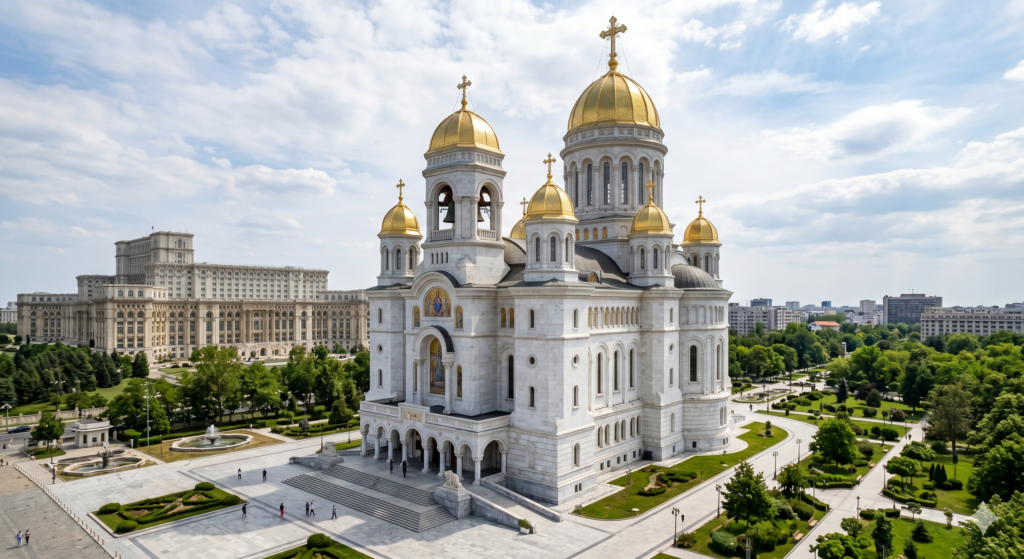
Dominating the skyline of Romania’s capital, the People’s Salvation Cathedral (Catedrala Mântuirii Neamului) is more than just a place of worship—it is a record-breaking feat of engineering and a profound symbol of national identity. As the tallest and largest Orthodox church in the world, it has become a “must-see” landmark for anyone visiting Bucharest.
To understand the sheer scale of this structure, one has to look at the statistics. It isn’t just big; it’s monumental.
While the building looks modern, the idea behind it is over 140 years old. After the Romanian War of Independence in 1877-1878, King Carol I first proposed a representative national cathedral.
However, due to world wars and decades of communist rule, the project was shelved for a century. It wasn’t until November 25, 2018, that the cathedral was finally consecrated, marking the centenary of the Great Union of Romania.
One of the most breathtaking features of the interior is the iconographic program. The cathedral is being decorated with Byzantine mosaics covering an area of approximately 25,000 square meters.
Note: The Altar mosaic is particularly famous, featuring an 11-meter tall representation of the Virgin Mary (Platytera), which is one of the largest of its kind in the world.
Located on Arsenal Hill, right next to the Palace of the Parliament (the world’s second-largest administrative building), the cathedral creates a striking contrast. While the Palace represents the era of Nicolae Ceaușescu, the Cathedral is seen by many as a symbol of “salvation” and spiritual recovery after the hardships of the 20th century.